
In the world of amateur radio, timing isn’t just everything—it’s the only thing. If you’ve ever sat in your shack at dawn or dusk and watched the bands suddenly “explode” with signals from halfway across the planet, you’ve witnessed the magic of Greyline Propagation.
While most hams hunt for DX during the height of the day or the dead of night, the real pros wait for the 30-minute window when the sun is either rising or setting. Here is why the “terminator line” is the ultimate long-distance highway.
What is the Greyline?
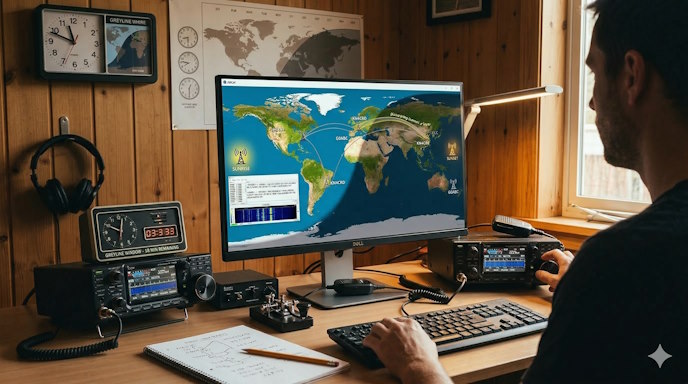
The Greyline (or Terminator) is the moving line that separates daylight from darkness on Earth. Because the Earth is a sphere, this transition isn’t instantaneous; it’s a twilight zone where the upper atmosphere is still bathed in sunlight while the ground is dark.
The Science of the “Golden Window”
To understand why this works, we have to look at the two layers of our ionosphere that act like a “gatekeeper” for your signal:
- The D-Layer (The Sponge): This lower layer exists only during the day. It is highly ionized and acts like a giant sponge, absorbing HF signals (especially on 40m, 80m, and 160m).
- The F2-Layer (The Mirror): This higher layer is what reflects (skips) your signal across the globe.
The Magic Trick: At the Greyline, the D-layer (the sponge) disappears rapidly as the sun sets, but the F2-layer (the mirror) remains highly ionized for a short time. This creates a temporary “low-loss” tunnel. Your signal can travel thousands of miles along this terminator line with almost zero absorption.
How to Work the Greyline
Greyline DXing isn’t about luck; it’s about geography and a clock.
- The Path: Your best DX will be with stations located on the opposite side of the terminator. For example, if it is sunrise in New York, the greyline runs down through South America and across to sunset in Central Asia or Western Australia.
- The Bands: While 20m works well, the “Low Bands” (30m, 40m, 80m, and 160m) see the most dramatic boost. These bands are normally restricted by D-layer absorption during the day, but the greyline opens a portal to the other side of the world.
[Table: Typical Greyline DX Paths by Season]
| Your Season | Sunrise Path (Morning) | Sunset Path (Evening) |
| Equinox (Mar/Sept) | North/South (Polar) | North/South (Polar) |
| Summer (June) | Toward SE (e.g., USA to VK/ZL) | Toward NW (e.g., USA to EU) |
| Winter (Dec) | Toward NE (e.g., USA to EU) | Toward SW (e.g., USA to VK/ZL) |
Pro Tools for the Hunt
You don’t need a massive beam to work Greyline DX, but you do need to know where the line is.
- Computer Maps: Software like Winlog32, N1MM, or online tools like DXMaps and RSGB’s Greyline Map show the terminator moving in real-time.
- The 30-Minute Rule: Start monitoring 15 minutes before your local sunrise/sunset and stay for at least 15 minutes after. The peak often lasts only 10 to 20 minutes.
- The “Long Path” Surprise: Don’t just point your antenna at the station. Sometimes, the Greyline allows for “Long Path” propagation, where the signal travels the long way around the world along the terminator to reach you.
The Greyline Secret: Signals on the greyline often have a “hollow” or “echo” sound. If a station sounds like they are in a cathedral, you’ve likely found the greyline pipe!
Summary
The Greyline is the great equalizer. It allows a 100-watt station with a simple wire dipole to outwork a “Big Gun” station just by being on the air at the exact right minute. Set your alarm, brew some coffee, and get ready for the 30 most exciting minutes of your radio day.