
If you’ve ever been scanning the 6-meter or 2-meter bands during a quiet summer afternoon only to have your speakers suddenly explode with a station from 1,200 miles away, you’ve experienced Sporadic-E (Es).
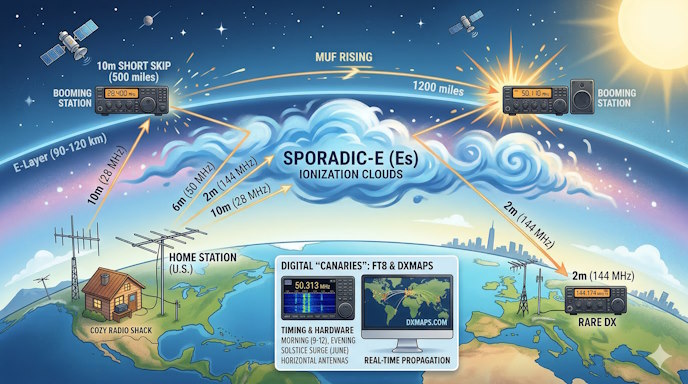
Unlike regular propagation, which follows the sunspot cycle, Sporadic-E is a seasonal mystery. It involves intense “clouds” of ionization forming in the E-layer (90-120 km up). As we head into the Summer 2026 season (peaking from late May through July), here is how to position yourself to catch these elusive openings.
1. Watch the “Step-Up” Effect
Sporadic-E is frequency-dependent. It almost always starts on the lower bands and “clouds up” to the higher frequencies. If you want to catch a rare 2-meter opening, you must watch the lower bands like a hawk.
- The 10m Early Warning: When you hear “short skip” on 10 meters (stations from 500 miles away sounding like they are in your front yard), the MUF (Maximum Usable Frequency) is rising.
- The 6m “Magic” Trigger: Once 6 meters (50 MHz) is wide open with extremely strong signals, start monitoring 2 meters (144 MHz).
- The Rule of Thumb: If you hear 6-meter stations at very short distances (under 400 miles), the ionization is incredibly dense. This is the “Golden Window” for 2-meter Es.
2. Monitor the Digital “Canaries”
In 2026, the best way to spot an opening isn’t by listening to static—it’s by watching the digital waterfalls.
- FT8 is your Scout: Set your rig to 50.313 MHz or 144.174 MHz. Even if you can’t hear a signal, the FT8 software will decode stations deep in the noise, giving you an “early alert” that a path has opened.
- PSK Reporter & DXMaps: Use these real-time tools to see where the “clouds” are currently located. If you see a cluster of lines forming between your region and another, aim your beam at the midpoint of that path.
[Image: Real-time DXMaps visualization showing a dense cluster of 6m contacts over Europe/North America]
3. Timing is Everything
While it’s called “sporadic,” this mode follows a predictable daily rhythm.
- Morning Peak: 09:00 to 12:00 local time.
- Late Afternoon/Evening Surge: 16:00 to 20:00 local time.
- The “Solstice Surge”: The two weeks surrounding the Summer Solstice (June 21st) are historically the most active days of the year for VHF enthusiasts.
4. Hardware for the Hunt
You don’t need a massive tower to work Sporadic-E, but you do need the right orientation.
- Polarization Matters: While FM repeaters use vertical polarization, most weak-signal Es (SSB/CW/FT8) happens on Horizontal polarization. A simple 2-element horizontal Yagi or even a resonant dipole will outperform a massive vertical whip.
- The “Short-Hop” Strategy: Because the reflection angle is so sharp, your antenna doesn’t need to be 100 feet in the air. Often, “lower is better” for the high-angle reflections typical of Sporadic-E.
Summary: The Es Hit-List
| Band | Probability | Distance (Single Hop) | Difficulty |
| 10 Meters | Very High | 500-1,500 miles | Easy |
| 6 Meters | High | 600-1,400 miles | Medium |
| 2 Meters | Rare | 800-1,200 miles | Hard |
Pro Tip: Keep a “calling frequency” list programmed into your radio’s memory. On 2m, stay tuned to 144.200 MHz (SSB) or 144.174 MHz (FT8). When the cloud aligns, you may only have 90 seconds to make the contact before the “mirror” in the sky vanishes!