Emergency Comms 101: Why Amateur Radio is the Most Professional Backup During a Grid Failure

When the power grid collapses and the cellular network is overwhelmed by “all circuits busy” messages, the primary infrastructure we rely on for modern life becomes a series of silent towers and dark screens. It is during these critical moments that the label “Amateur” radio becomes a misnomer. In a true emergency, the amateur radio service stands as the most resilient, flexible, and professional communication backbone available to the public.
The Problem of Infrastructure Dependency
The most significant weakness of modern communication is its total reliance on complex, fragile infrastructure. Your smartphone is not a radio in the traditional sense; it is a low-power microwave terminal that requires a functioning cell tower, fiber-optic backhaul, and a constant supply of electricity to every node in the chain. If any one of those links breaks—whether due to a cyberattack, solar flare, or natural disaster—the device becomes a paperweight.
Amateur radio operates on a different principle: point-to-point independence. A ham radio operator with a battery, a transciever, and a length of wire thrown over a tree limb can communicate across the city or across the globe without a single piece of intermediate infrastructure.
Resilience Through Simplicity
The “professionalism” of amateur radio in emergencies lies in its simplicity and the skill of its operators. While government agencies often rely on satellite phones that require a clear view of the sky and a functioning satellite constellation, radio amateurs utilize the ionosphere—a natural layer of the atmosphere that reflects radio waves back to Earth.
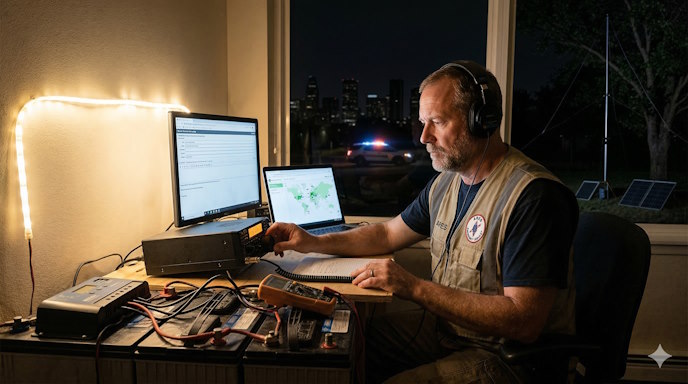
Because hams are used to working under less-than-ideal conditions, they have mastered the art of “weak signal” communication. During a grid failure, they aren’t just talking; they are passing formal messages known as Radiograms, coordinating logistics for local shelters, and providing real-time ground truth to emergency managers who may be blinded by a lack of data.
The Technician’s Advantage: Off-Grid Capability
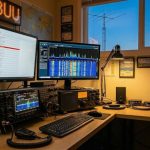
The amateur radio community is uniquely prepared for a “black start” scenario. Most serious operators maintain stations that can run entirely on renewable energy.
- Solar and Battery Power: Many home stations (shacks) are equipped with deep-cycle batteries and solar arrays, allowing them to operate indefinitely when the local utility fails.
- Portable Deployment: The ability to pack a station into a backpack and hike to high ground is a core skill of the hobby, often practiced during events like “Field Day.”
- Alternative Modes: Beyond voice, hams use digital modes like Winlink, which allows them to send and receive email over radio waves. This means a ham in a disaster zone can send an email to a recipient in a functional part of the world with no internet connection at the source.
Training and the Human Element
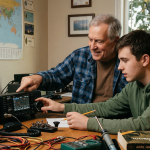
Equipment is only half of the equation. The true value of the service is the licensed operator. Amateur radio licenses require a demonstrated understanding of electronics, wave propagation, and regulatory procedures. This training ensures that when an emergency occurs, the airwaves aren’t filled with chaotic noise, but with disciplined, efficient traffic.
In a crisis, information is the most valuable currency. By providing a bridge between isolated communities and the outside world, amateur radio operators prevent the “information vacuum” that often leads to panic. They remain the final fail-safe—the one system that works when everything else has failed.