As we move through March 2026, we are in a rare and exhilarating “sweet spot” for amateur radio. While early predictions suggested Solar Cycle 25 would be a quiet one, it has turned out to be a powerhouse, with sunspot numbers (SSN) recently hitting levels we haven’t seen in over 20 years.
However, the clock is ticking. Most experts agree we are currently at or very near the definitive peak of the cycle. By late 2026, the slow slide toward solar minimum will likely begin. Here is how to maximize your logbook while the ionosphere is still “wide open.”
1. Target the “Magic” High Bands (10m, 12m, and 15m)
During solar minimum, these bands can be “dead as a doornail” for years at a time. Right now, they are the stars of the show.
- 10 Meters (28 MHz): This band is currently providing worldwide DX with even the most modest setups. Because the F2 layer is so heavily ionized, “low-power” (QRP) stations and simple vertical antennas are working into other continents daily.
- 12 Meters (24 MHz): Often overlooked, this is the “gentleman’s band.” It offers propagation similar to 10m but with much less contest noise and QRM (interference).
- The Strategy: If you see an SFI (Solar Flux Index) above 150, stop what you’re doing and get on 10 meters. These are the days we will be talking about in ten years.
2. The 6-Meter “Trans-Equatorial” Bonus
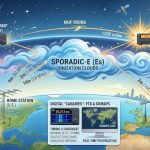
We are in the prime window for Trans-Equatorial Propagation (TEP) on 6 meters ($50\text{ MHz}$). During the solar peak, the ionosphere becomes dense enough to support 6m contacts over massive distances—often between the northern and southern hemispheres—well after sunset.
- Watch for: “Double-hop” Sporadic E combined with F2 propagation. If you hear stations from South America or Africa on 6m, the “Magic Band” is truly living up to its name.
3. Embrace the “Watery” Polar Paths
With a high SFI, paths over the poles (e.g., US Midwest to Central Asia) become viable. However, be prepared for the “Auroral Flutter.” Signals coming over the poles often have a distinct, rapid wavering sound caused by the high energy in the auroral oval.
- Pro Tip: If a signal sounds like it’s underwater, don’t assume your radio is broken. It’s the sound of the solar peak at work!
4. Gear Up for the Decline
When the cycle eventually starts to decline (predicted for late 2026 into 2027), the “best” bands will shift back down.
| Phase | Best Daytime Bands | Best Nighttime Bands |
| Peak (Now – Mid 2026) | 10m, 12m, 15m, 17m | 20m, 30m, 40m |
| Decline (Late 2026+) | 15m, 17m, 20m | 40m, 80m, 160m |
Summary: Your Peak Checklist
- Monitor the SFI: Look for values >150 for “High Band” glory.
- Check the K-Index: Even at the peak, a geomagnetic storm (K = 5) can shut everything down.
- Go High: Prioritize 10m and 12m while they are still open; 20m and 40m will always be there during the lean years.
Final Thought: We are currently living through the “Good Old Days” of Solar Cycle 25. Whether you’re chasing DXCC or just enjoying a local ragchew, get on the air now. The sun is giving us a gift—don’t let it go to waste.